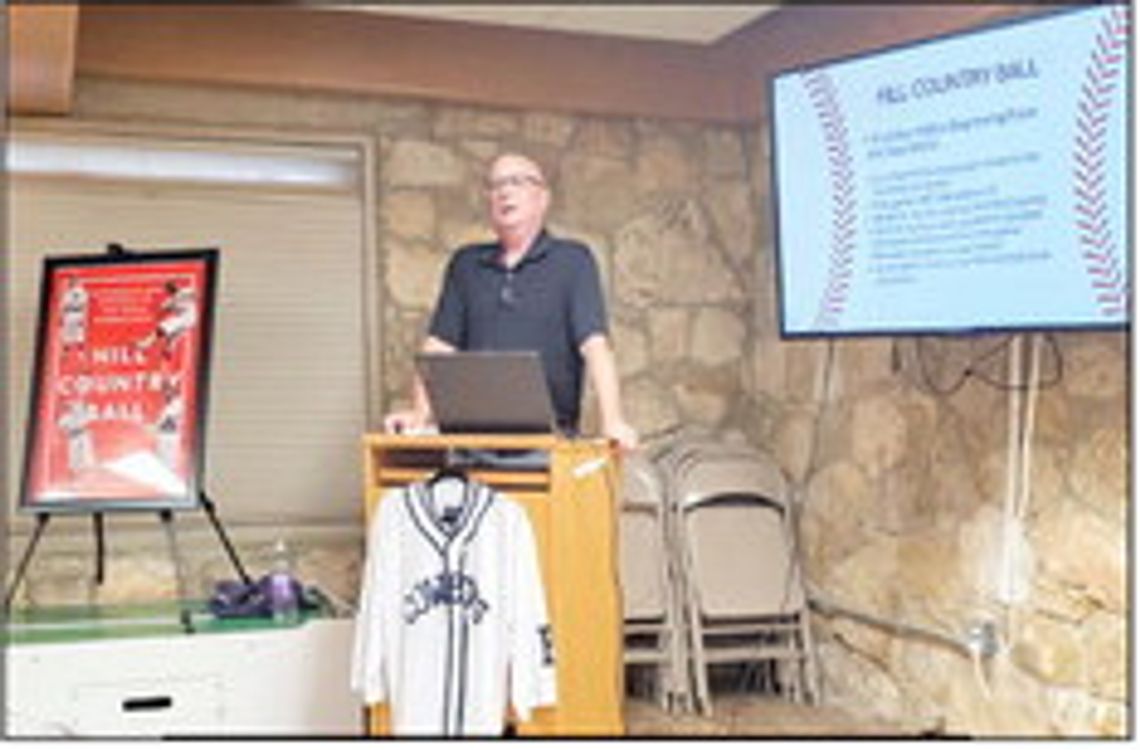
The Bandera Kronkosky Library hosted author Richard W. Butler, who wrote “Hill Country Ball,” for a presentation on the history of community baseball teams in the Texas Hill Country.
Butler spoke to a small but enthusiastic audience about the teams that shaped the region’s baseball history.
A resident of Boerne, Butler moved to the Hill Country after a 37-year career as a county attorney in Michigan.
After vacationing in the area, he and his wife decided to move to Texas. A lifelong baseball enthusiast, Butler began volunteering at the Boerne Library, where he discovered a wealth of information about Hill Country teams dating from before the Civil War through the 1960s.
Butler divides the history of baseball in Central Texas into five periods.
The first, from the Civil War through 1899, saw baseball spread south into the Confederacy as Northern prisoners of war began playing the game.
The first reported baseball game in Texas was played in Galveston in 1867.
From there, the sport moved west into Central Texas. Although Abner Doubleday has been credited with bringing baseball to Galveston, later research indicates he was a West Point cadet at the time and was unlikely to have been involved.
Butler noted that the German culture of the Hill Country readily embraced baseball. German residents were familiar with the concept of the “verein,” or club, which emphasized structured rules, athleticism and community support.
Baseball teams sprang up in towns across the region, with Sunday afternoon games offering opportunities for picnics, community entertainment and friendly competition.
The first reported game between Kerrville and Bandera took place in 1891, featuring the rough-and-rowdy play characteristic of the Hill Country rivals.
The period from 1900 to 1929 brought more regular schedules and established team names. Regional teams included the Bandera Cowboys, Comfort Broncos, Fredericksburg Giants, Boerne White Sox, Kerrville Athletics, Llano Cowboys and Mason Mavericks.
Most town teams were managed by associations of local businessmen, and most players lived in the communities they represented.
Occasionally, teams recruited “ringers,” usually pitchers from military posts in San Antonio, who were paid what was then considered an extraordinary fee of $5 per game. Admission cost 40 cents before dropping to 25 cents during the Great Depression.
Another notable figure in Hill Country baseball was Dizzy Dean, who played for several local teams as a teenager.
Butler described 1930 to 1936 as the “halcyon days” of Hill Country baseball. The first league, the Hill Country League, formed in 1930 with teams from Boerne, Comfort, Kerrville, Fredericksburg and Mason. Junction replaced Boerne in 1931, and Brady replaced Comfort in 1932.
Kerrville established the Mountain League in 1933, featuring teams from Bandera, Boerne, Comfort, Kerrville and Alamo Heights. San Saba replaced Kerrville in the Hill Country League, creating northern and southern leagues.
The Bandera Cowboys struggled in the Mountain League. In 1933, they finished fifth among six teams with a 4-14 record. They posted a 2-12 record in 1934 and finished sixth among six teams in 1935 with a 2-16 record.
Butler also discussed family names associated with Bandera baseball, including Jenschke and Hamilton.
After 1936, Hill Country baseball entered a period of change and disorganization. The Mountain League dissolved in 1936, followed by the Hill Country League after that season.
By the 1960s, town teams had disappeared, in part because of television's growing popularity and the introduction of other sports, including football and basketball.
Butler also highlighted the Kerrville All-Stars as an example of Black baseball in Texas. Many talented players went on to compete for Black semiprofessional and professional teams.
In Kerrville's Black community, three important institutions were the Methodist and Baptist churches, Doyle School and the All-Stars baseball team. Butler's chapter on Black baseball in Texas offers a glimpse into the Jim Crow culture of the era.
Filled with historical details and entertaining stories, Butler's book offers baseball enthusiasts and local history buffs an engaging look at the sport's legacy in the Texas Hill Country. It also makes a fitting Christmas gift for baseball fans and local historians.