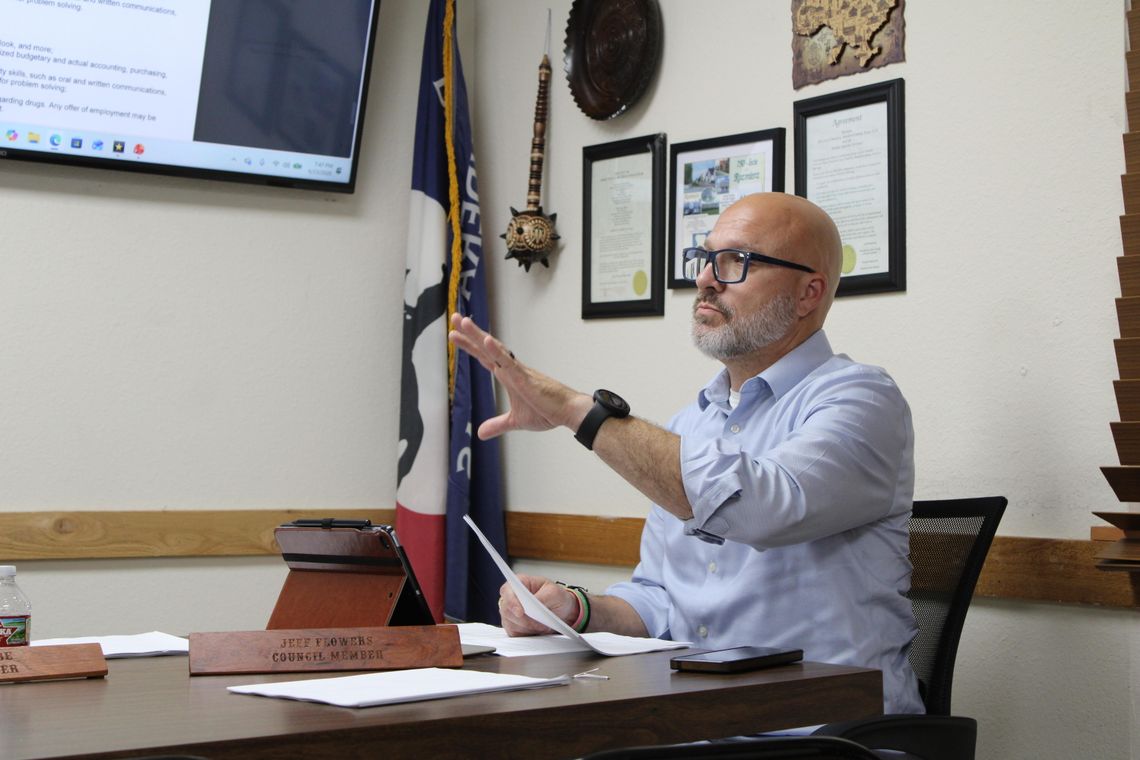
Sharp divisions over the city's canceled Flock Safety camera program resurfaced during the June 23 Bandera City Council meeting as two council members criticized Mayor Denise Griffin for remaining silent following recent reporting by The Bulletin and questioned whether Councilman Jeff Flowers should face sanctions over a pair of public letters defending the technology.
Council members Deanna McCabe and Tammy Morrow raised concerns after The Bulletin published emails obtained through an open records request showing city officials continued advancing the Flock Safety program despite growing public opposition and concerns from council members. The discussion also centered on two letters Flowers published following the council's May 12 vote to terminate the city's agreement with the automated license plate reader company.
One of those letters, "The Bandera Declaration of Digital Independence," drew local and national attention after proposing sweeping technology restrictions, including bans on smartphones, GPS-enabled devices and internet services within city limits. Flowers later said the piece was satire modeled after Jonathan Swift's 1729 essay "A Modest Proposal" and intended to highlight what he viewed as inconsistencies in arguments against license plate reader technology.
During Tuesday's meeting, McCabe said she believed city leadership should have publicly distanced itself from the letters.
"I believe a statement should have went out that indicated this is not the views of the city of Bandera or the council," McCabe said. "The newspaper article, in my opinion, made a mockery of the city and the citizens of Bandera."
McCabe also took issue with Flowers' statement that he intended to pursue resolutions restricting certain technologies.
"That no longer becomes freedom of speech," McCabe said. "I probably wouldn't have even considered looking at it if it was on someone's social media page, but this was something that was submitted to newspapers – the city of Bandera's official newspaper at that. And we were getting emails, ridiculous, vulgar emails from all over the country and beyond."
The criticism comes amid continued fallout from the council's 3-2 vote in May to terminate the city's contract with Flock Safety. Council members McCabe, Debbie Breen and Morrow voted to end the agreement, while Flowers and Lynn Palmer voted against cancellation.
Emails published by The Bulletin earlier this month showed Griffin directed city staff on March 26 to proceed with camera installations despite mounting opposition and ongoing discussions about canceling the contract. The correspondence also showed city officials privately acknowledging that support for the program among council members was eroding.
Although concerns about Flowers' conduct were raised during Tuesday's meeting, the council took no action and did not pursue formal sanctions.
Neither Griffin nor Flowers responded during the council discussion.
In a statement provided to The Bulletin on Wednesday, Flowers defended both his letters and his decision not to respond during the meeting, arguing that the agenda item was intended to target him politically.
Flowers' full statement follows:
"I chose to remain silent during last night's meeting because our city council chambers are meant for municipal business, not for placing items on the agenda solely for political posturing to target and attack individuals without true merit.
It is deeply hypocritical that certain council members are attempting to weaponize sanctions as a tool to silence differing perspectives. The narrative they are pushing is clear: it is acceptable for select officials to express their opinions, but if anyone's perspective does not align with theirs, they want to inflict punishment.
My recent letters to the editor were written after the council's vote to terminate the grant funded Flock was finalized, sharing my personal perspective as both a resident and a council member, not speaking on behalf of the council body.
I used satire to call out an obvious double standard: critics raise massive concerns about privacy over a state-funded law enforcement camera, yet completely ignore the smart phones, smart watches, and everyday apps that track our data every single second. Yet opponents' arguments shift away from that.
For example: Claims that crime is non-existent locally or only a very small percentage of crime actually happens. Convictions and cases solved are not a reflection of all the crime that takes place.
Texas alone faces roughly 30,000 robberies and 97,000 vehicle thefts annually, alongside 28,229 missing children reports documented by the Texas DPS in 2025. The reality is that the vast majority of crimes go completely unsolved, leaving families without justice.
In my opinion, any crime is too much crime, and my focus is to ensure our law enforcement has the tools necessary to generate leads and protect local families from transient offenders.
My faith in Christ teaches me to love my neighbors and that there is no greater love than sacrificing your own life for another.
If placing LPR technology in our town saves just one single life, I will happily give up my expectation of privacy in a public space. Especially on a public road where no real expectation of privacy exists in the first place.
I am not going to let political theater distract me from the job the residents elected me to do: managing our local resources responsibly and prioritizing the actual safety of our community. In this I will not waiver.
Jeff Flowers"



.png)